




![[EXCLUSIVE] Brendan Gan Delivers One of Malaysia’s Best-Ever Worlds Results, Shares Thoughts on Pressure and the Local Scene](https://cdn.gamerbraves.com/2026/08/Brendan-Gan_Interview_FI-360x180.jpg)






![[BIC2026] Hiroaki Nagashima from Toei Games Talks New IPs, Indie Roots, and Asia-First Strategy](https://cdn.gamerbraves.com/2026/08/Toei-Games-BIC-2026_Interview_FI-360x180.jpg)
![[BIC2026] From Outsider to Organizer: How Isabella Seo Jungsook Helped Build Busan’s Indie Game Scene through BIC](https://cdn.gamerbraves.com/2026/08/Isabella-BIC-2026_Interview_FI-360x180.jpg)
![[BIC2026] CanOpener’s Logan Moon Opens Up About Dungeon Settlers Ahead of Its September Early Access Launch](https://cdn.gamerbraves.com/2026/08/Logan-Moon-BIC-2026_Interview_FI-360x180.jpg)


![[Guide] Monster Hunter Stories 3: Twisted Reflection – A Complete Guide to Habitat Restoration](https://cdn.gamerbraves.com/2026/03/MHS3-Habitat-Restoration-Guide_Guide_FI.jpg)
In Monster Hunter Stories 3: Twisted Reflection, Habitat Restoration is one of the most important progression systems in the game. Rather than simply collecting Monsties and moving on, players take on the role of a Ranger tasked with restoring ecosystems damaged by Crystallization. Entire maps across the game’s world, and Habitat Restoration allows players to rebuild these environments by reintroducing Monsties back into the wild.
This system connects exploration, Monstie collection, team building, and long-term progression. More importantly, it also allows players to influence elemental traits in their Monsties by placing them in regions with different elemental alignments. Because of this, understanding how ecosystems work—and where each element is located—is essential if you want to optimize your Monstie builds.
This guide will contain major spoilers, so please take note of that before scrolling through!
How Habitat Restoration Works
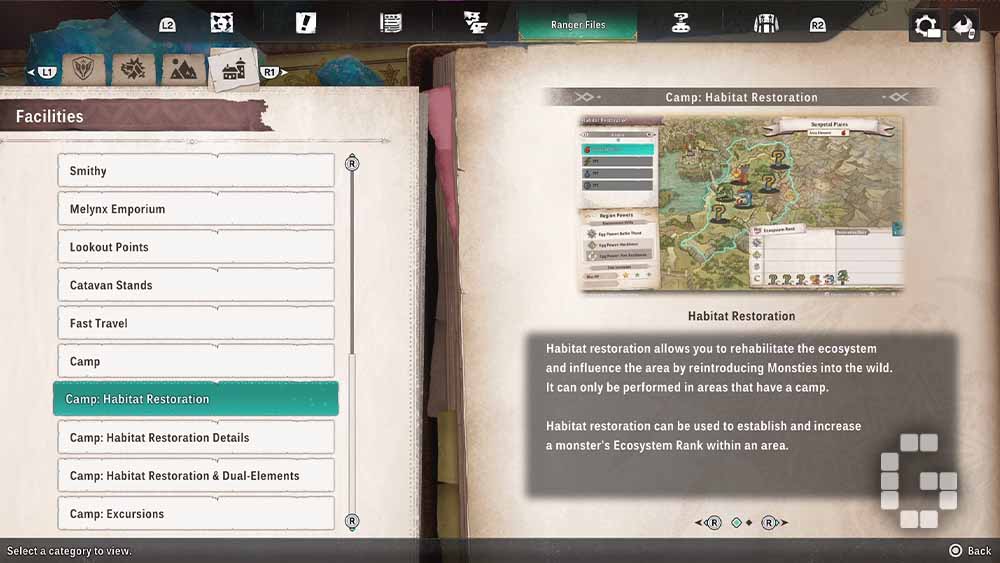
Habitat Restoration allows players to rehabilitate ecosystems by placing Monsties back into the wild. However, restoration can only be performed in areas that contain a camp, which acts as the ecosystem management hub for that region.
Each map contains 10 habitat slots:
- 5 Native Slots (Original Inhabitants) – These monsters are permanent residents of the region and cannot be replaced.
- 5 Restoration Slots (Player-Controlled) – These are the slots players can fill with Monsties of their choice. These slots are the main tool for shaping ecosystems, raising species ranks, and obtaining rare or Deviant Monsties.
Understanding the difference between native and restoration slots is essential. Native monsters provide stability and maintain the region’s inherent elemental traits, while restoration slots allow players to actively modify the ecosystem and maximize Habitat Restoration benefits.
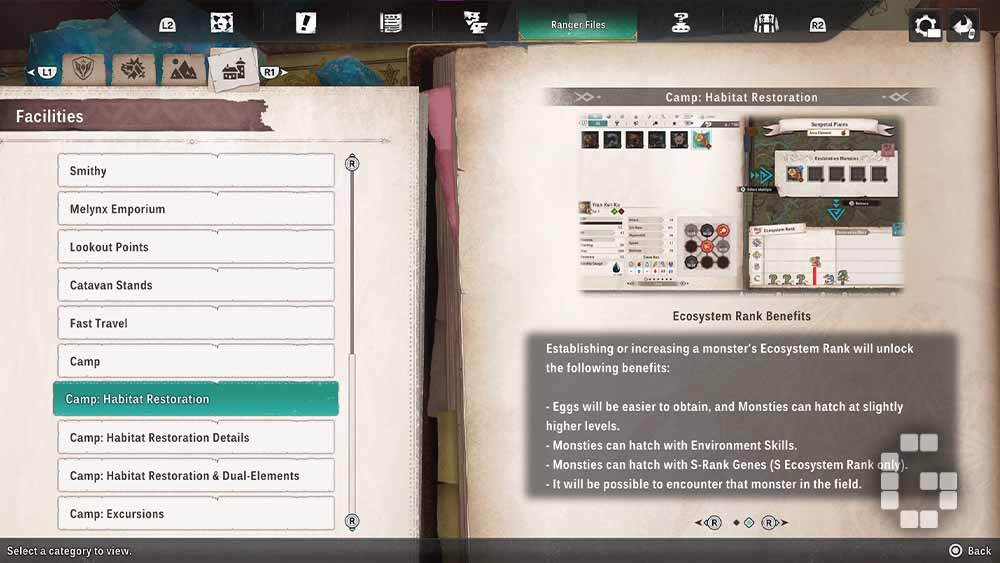
By placing Monsties into a habitat, players establish or increase that monster’s Ecosystem Rank in the specific region. Each monster has a separate rank for each region it inhabits, rather than a global score. For example, a Silverwing Nargacuga may have an S Rank in Sunpetal Plains but only an A Rank in Mirror Lake.
As a monster’s Ecosystem Rank increases in a region, the ecosystem becomes healthier and more stable, unlocking several gameplay benefits:
- Eggs become easier to obtain from nests
- Monsties can hatch at slightly higher levels
- Monsties may hatch with Environment Skills depending on their ranks, with S Rank Monsties able to inherit all 3 Environment Skills
- Monsters with high ecosystem presence in a region can appear naturally in the field
While adding more monsters improves ecosystem ranks, there’s a strategic trade-off: regions have a maximum amount of spawn points, which all monsters share. The more monsters placed in a habitat, the more competition there is for these spawn points, meaning some monsters—particularly flying types—can become harder to encounter. Flying monsters are unique in that they can occupy both aerial and ground spawn points, so careful planning is necessary if you want specific monsters to appear frequently.
Because of these benefits and considerations, Habitat Restoration becomes one of the most effective ways to strengthen your team and expand your monster roster—but players must carefully balance which monsters they place and where.
Increasing Ecosystem Rank Faster
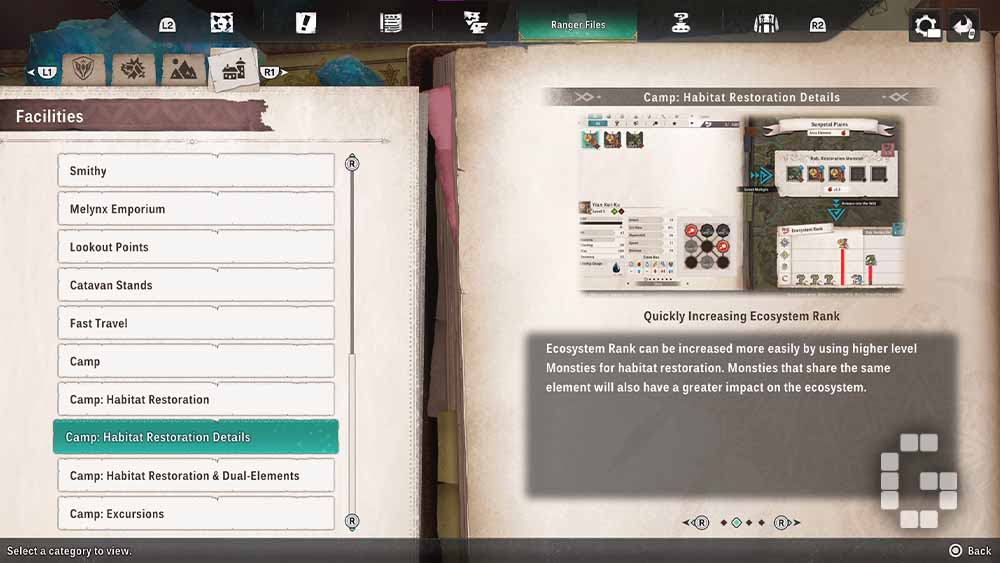
While a monster’s Ecosystem Rank naturally grows as it is placed in a habitat, there are ways to accelerate its progression:
- Use higher-level Monsties during restoration.
- Release multiple Monsties of the same element at the same time – releasing Monsties that share the same element increases the multiplier for raising each monster’s Ecosystem Rank.
- Release multiple Monsties of the same species at the same time – releasing Monsties of the same species similarly boosts the multiplier for raising each monster’s Ecosystem Rank.
Higher-level and elementally-aligned monsters strengthen the ecosystem more efficiently, allowing their Ecosystem Rank to rise faster. This system encourages players to carefully plan which monsters to place in each region to maximize benefits.
Note that each map has two Stat Bonuses for monsters: the first is available immediately, while the second is unlocked only after defeating the Elder Dragons in that map. The number of stars (up to 3) for each bonus scales with the overall Ecosystem Rank of all monsters in the map, making it important to develop monsters evenly across regions.
All Maps, Regions, and Elements
Understanding where each element exists is critical for Habitat Restoration. Since elements influence Monstie development, players should plan carefully when placing Monsties in each region.
Below is a breakdown of every map and region in the game, along with their elemental alignments.
Azuria
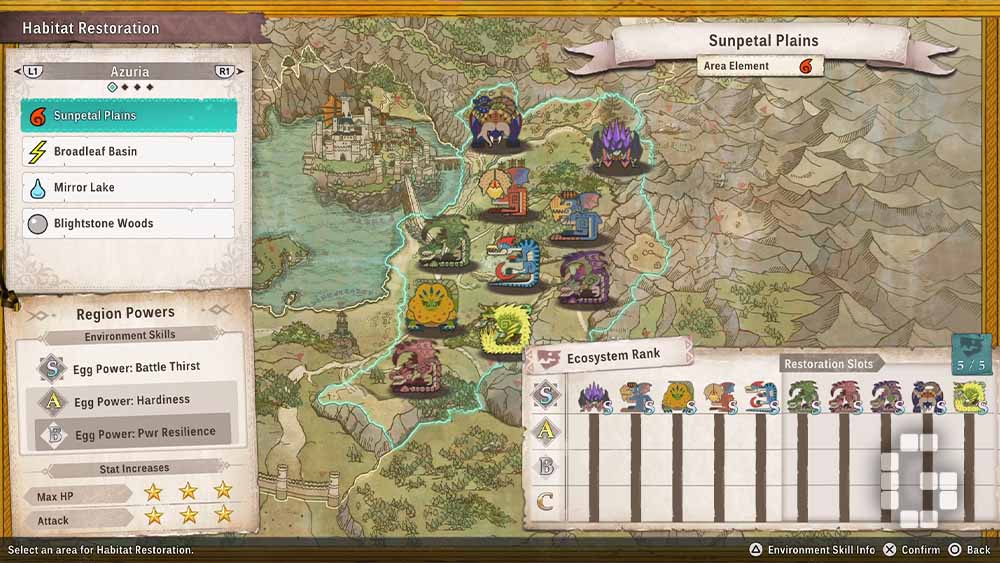
Azuria is the first major map players explore and introduces the Habitat Restoration system.
It contains four regions:
- Sunpetal Plains – Fire Element
- Broadleaf Basin – Lightning Element
- Mirror Lake – Water Element
- Blightstone Woods – Non-Element
Azuria is often where players first experiment with influencing Monstie elements by placing them into different habitats.
Azuria’s Environment Skills
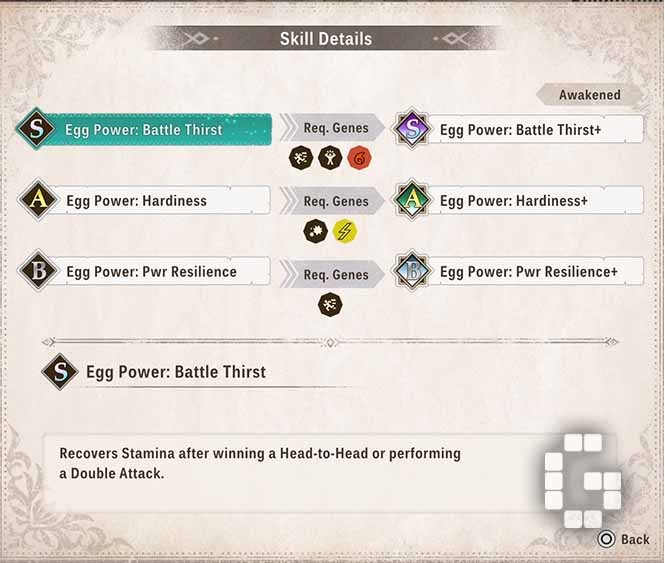
- S Rank – Battle Thirst
Recovers Stamina after winning a head-to-head or performing a Double Attack.
- A Rank – Hardiness
Slightly recovers Stamina after taking damage.
- B Rank – Power Resilience
Slightly reduces Power-type damage taken.
Azuria Stat Bonuses

- Max HP
- Attack
Canalta Timberland
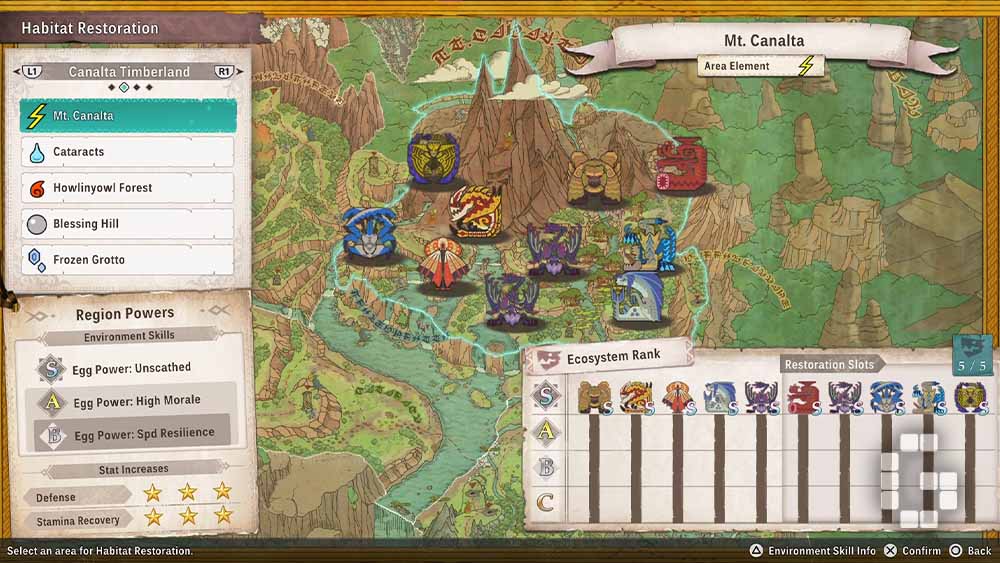
The habitats of Canalta Timberland | Image Credit: Digital braves
Canalta Timberland is the second major map and introduces more ecosystem variety.
It contains five regions:
- Mt. Canalta – Lightning Element
- Cataracts – Water Element
- Howlinyowl Forest – Fire Element
- Blessing Hill – Non-Element
- Frozen Grotto – Ice Element
The addition of Ice-element habitats allows players to start experimenting with more complex Monstie builds.
Canalta Timberland Region’s Environment Skills
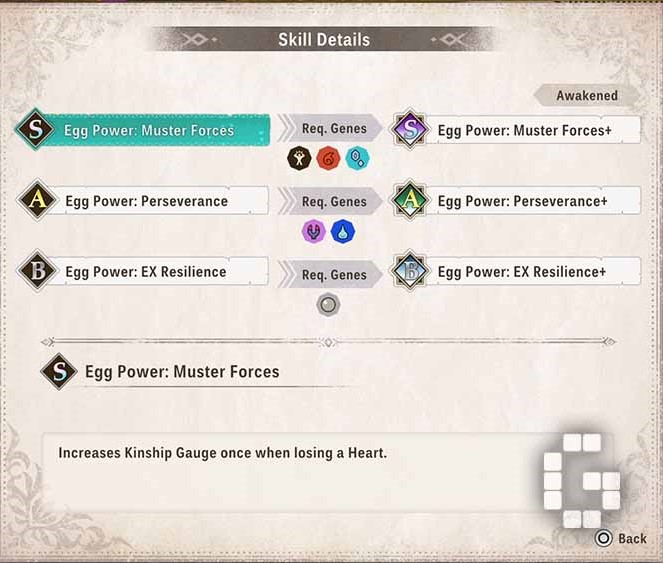
- S Rank – Unscathed
Negates damage after winning a head-to-head and increases damage dealt to enemies.
- A Rank – High Morale
Slightly extends the duration of buffs applied by your skills.
- B Rank – Speed Resilience
Slightly reduces Speed-type damage taken.
Canalta Timberland Stat Bonuses

- Defense
- Stamina Recovery
Tarkuan
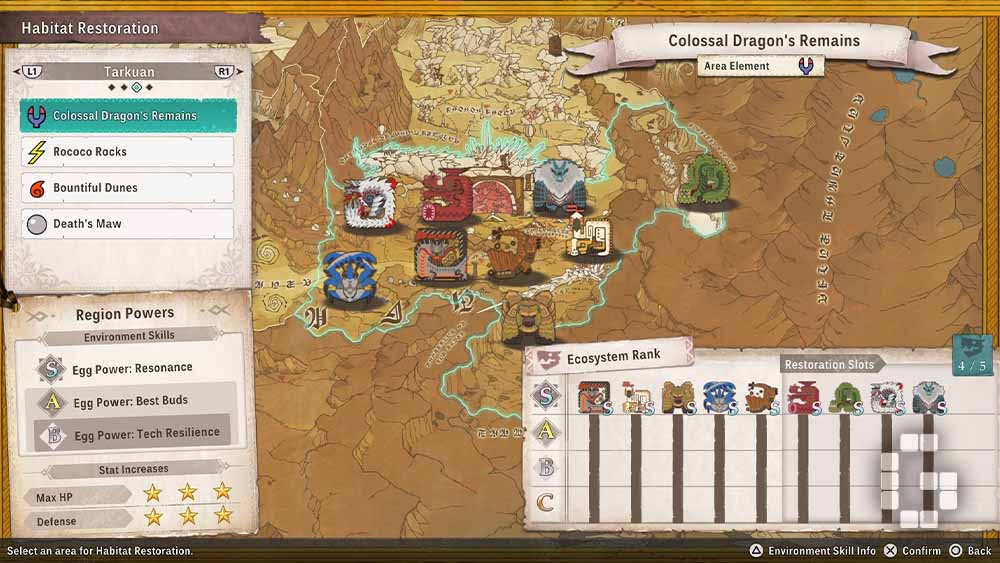
Tarkuan introduces Dragon-element ecosystems and stronger combat bonuses tied to the Kinship Gauge.
The regions in Tarkuan include:
- Colossal Dragon’s Remains – Dragon Element
- Rococo Rocks – Lightning Element
- Bountiful Dunes – Fire Element
- Death’s Maw – Non-Element
Dragon-element regions are particularly valuable because they allow players to experiment with one of the rarest elemental influences in the game.
Tarkuan Region’s Environment Skills
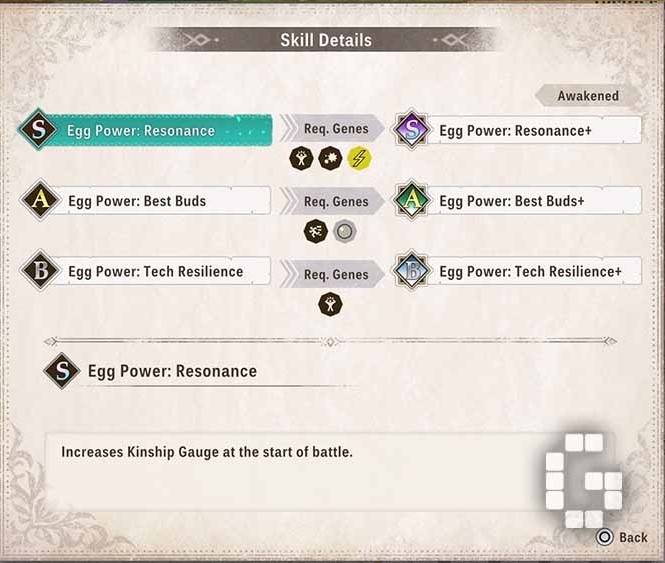
- S Rank – Resonance
Increases Kinship Gauge at the start of battle.
- A Rank – Best Buds
Riding Kinship Gauge fills slightly faster.
- B Rank – Tech Resilience
Slightly reduces Technical-type damage taken.
Tarkuan Stat Bonuses
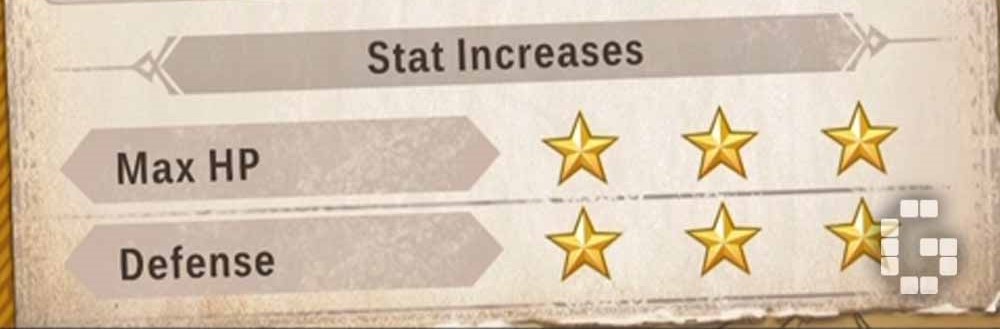
- Max HP
- Defense
Serathis
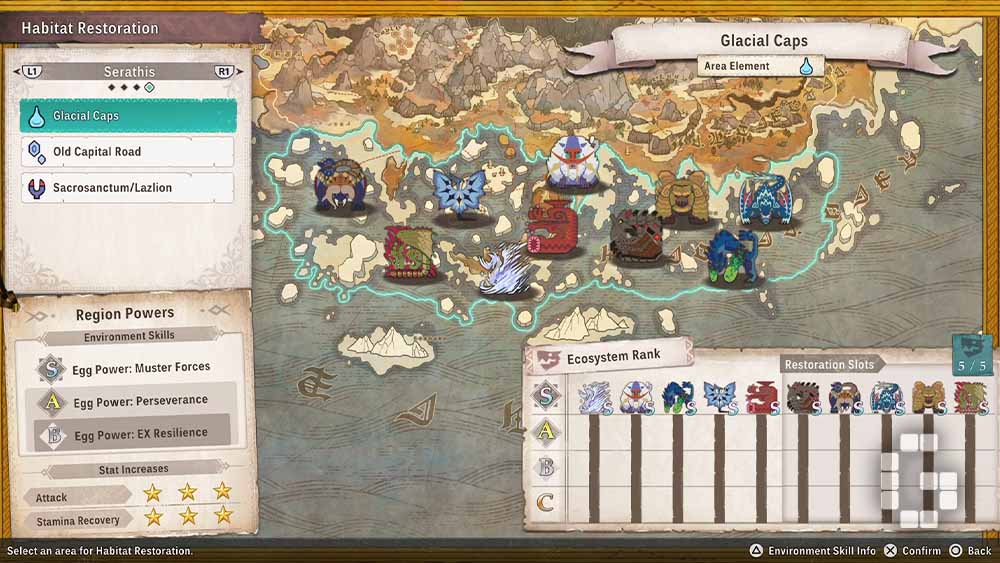
Serathis is the final major map and focuses heavily on survivability and late-game builds.
It contains three regions:
- Glacial Caps – Water Element
- Old Capital Road – Ice Element
- Sacrosanctum / Lazlion – Dragon Element
Because it contains both Ice and Dragon ecosystems, Serathis is extremely valuable for late-game Monstie development.
Serathis Region’s Environment Skills
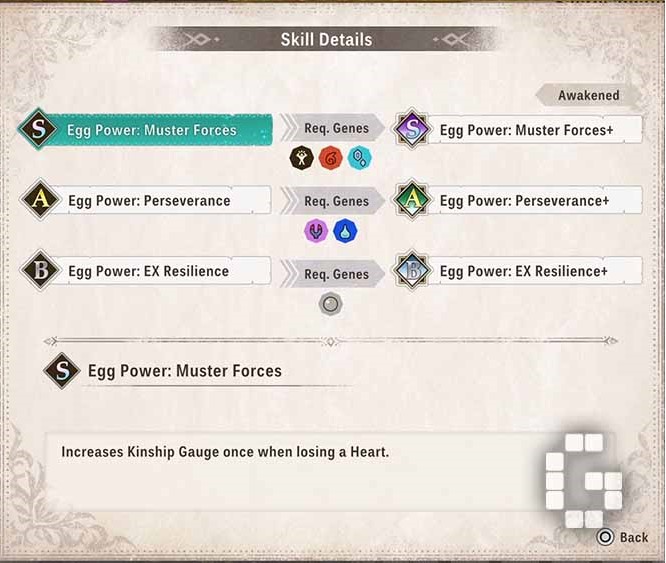
- S Rank – Muster Forces
Increases Kinship Gauge once when losing a Heart.
- A Rank – Perseverance
Revives once with newly applied buffs after losing a Heart.
- B Rank – EX Resilience
Slightly reduces No-Type damage taken.
Serathis Stat Bonuses

- Attack
- Stamina Recovery
Using Habitats to Influence Monstie Elements
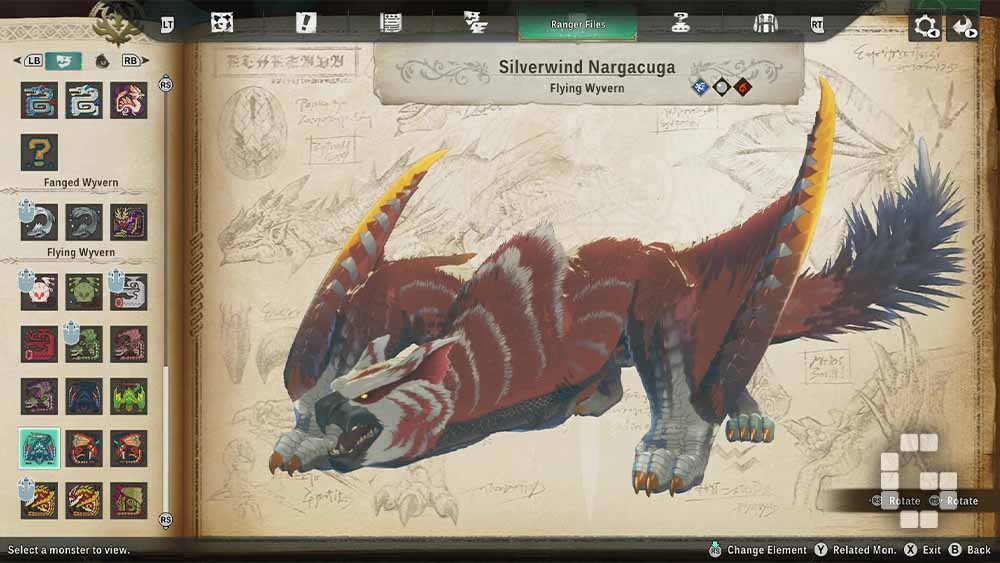
One of the most important mechanics tied to Habitat Restoration is the ability to influence a Monstie’s elemental traits.
Each region in the game has a specific element, and placing a Monstie into a region with a different element can influence its egg traits and gene inheritance.
This can eventually allow a Monstie to develop traits associated with a secondary element, opening up new combat possibilities.
Because of this, Habitat Restoration becomes a powerful tool for creating hybrid Monstie builds.
Ecosystem Slot Management
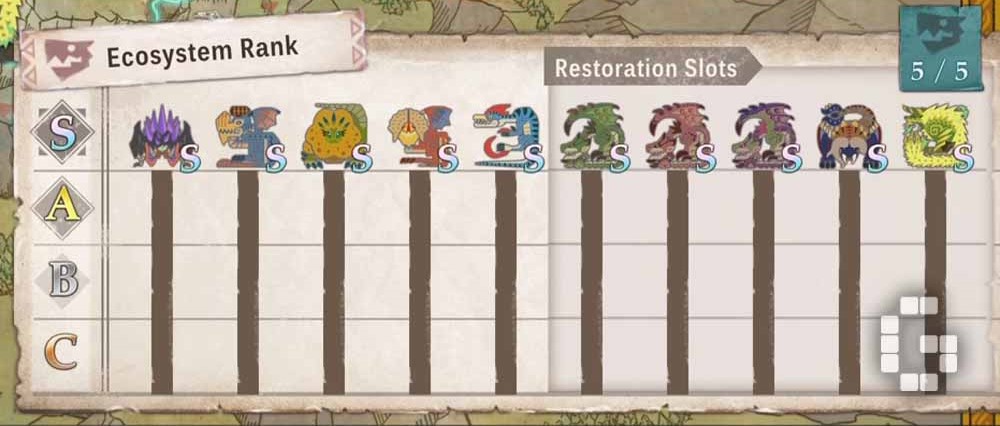
Each ecosystem contains two types of placement slots:
- Native Slots
- Restoration Slots
Restoration slots are used when adding Monsties during Habitat Restoration. However, each ecosystem has a limit of 5 restoration slots can be used.
If this limit is exceeded, players must remove a monster before placing a new one.
To prevent losing important Monsties, players can use Eco Conservation, which allows a Monstie to be permanently locked into a fixed slot. This ensures it remains part of the ecosystem even while restoration continues.
Slot management becomes increasingly important later in the game when players are trying to trigger complex mutation conditions.
Mutations and Rare Monsters
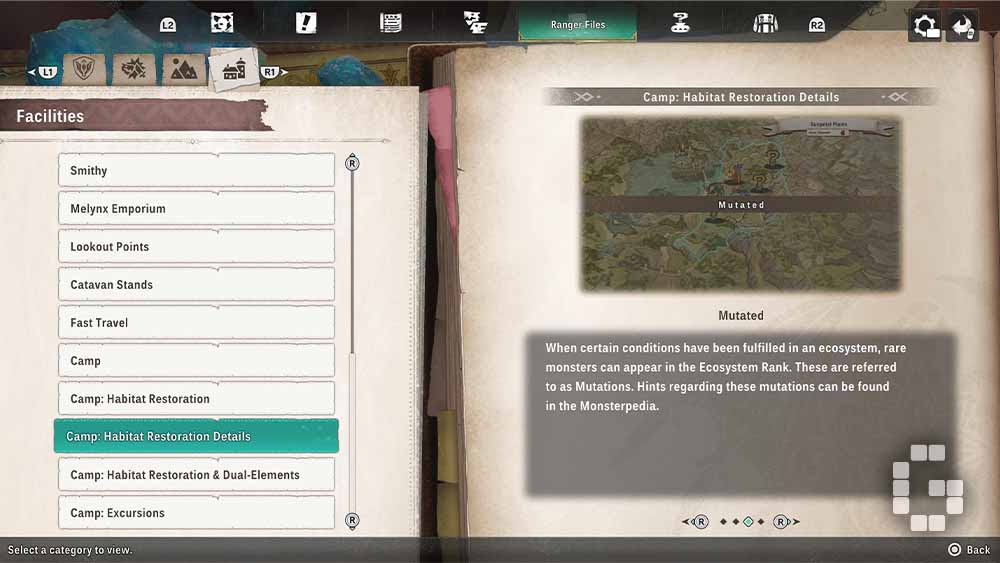
When certain conditions are fulfilled within an ecosystem, rare monsters may appear. These events are known as mutations.
Mutations can cause Monsties to evolve into Subspecies or Deviant variants, depending on the ecosystem setup.
Mutation conditions may include:
- Certain species combinations
- Specific elemental alignments in the habitat
- Minimum Ecosystem Rank requirements
- Presence of rare or Deviant Monsties
Unlike earlier games, Monster Hunter Stories 3: Twisted Reflection provides hints for these mutations through the Monsterpedia, allowing players to plan ecosystem setups rather than relying on luck.
This makes Habitat Restoration a strategic system where experimentation and planning can produce powerful results. You can follow the full guide on how to mutate monsters by checking it out here.
Environment Skills and Excursions
Environment Skills are powerful abilities tied to specific regions. These abilities can significantly improve a Monstie’s performance in combat.
As Ecosystem Rank increases, Monsties in that region are more likely to hatch with these skills.
Environment Skills can also be enhanced by combining them with compatible genes, allowing players to create specialized builds.
Players can also send Monsties on Excursions using Training Talismans.
Excursions allow Monsties to:
- Learn new Environment Skills
- Gain additional stat increases
This system allows Monsties to grow stronger even when they are not part of the active party.
Final Thoughts
Habitat Restoration in Monster Hunter Stories 3: Twisted Reflection is far more than a simple progression system. It allows players to actively rebuild ecosystems, influence monster populations, and shape how Monsties develop over time.
By understanding Ecosystem Rank, managing habitat slots, experimenting with elemental regions, and triggering mutations, players can create powerful and unique Monstie builds.
Because each map contains different elemental ecosystems and region bonuses, mastering Habitat Restoration is key to fully exploring the depth of the game’s progression and customization systems.


![[Guide] Monster Hunter Stories 3: Twisted Reflection – How to Farm for Better Genes](https://cdn.gamerbraves.com/2026/03/MHS3-Gene-Farm-Guide_GUIDE_FI-75x75.jpg)