









![[BIC2026] Hiroaki Nagashima from Toei Games Talks New IPs, Indie Roots, and Asia-First Strategy](https://cdn.gamerbraves.com/2026/08/Toei-Games-BIC-2026_Interview_FI-360x180.jpg)
![[BIC2026] From Outsider to Organizer: How Isabella Seo Jungsook Helped Build Busan’s Indie Game Scene through BIC](https://cdn.gamerbraves.com/2026/08/Isabella-BIC-2026_Interview_FI-360x180.jpg)
![[BIC2026] CanOpener’s Logan Moon Opens Up About Dungeon Settlers Ahead of Its September Early Access Launch](https://cdn.gamerbraves.com/2026/08/Logan-Moon-BIC-2026_Interview_FI-360x180.jpg)

![[EXCLUSIVE] From PlayStation to Indie Advisor: Shuhei Yoshida Talks Games, AI, and the Future of the Industry](https://cdn.gamerbraves.com/2026/08/Shuhei-Yoshida-BIC-2026-Exclusive_Interview_FI-360x180.jpg)



When a new PC game launches on Steam at USD $59.99, many players assume the price they see locally is simply a currency conversion. In reality, Steam uses a regional pricing system designed to balance affordability, local spending patterns, and market expectations across different countries.
In March 2026, Valve Corporation updated the economic dataset behind its regional pricing conversion tools. This update does not automatically raise game prices. Developers still control what their titles cost. However, the updated dataset alters the recommendations publishers see when preparing global price tiers. For players and developers in Southeast Asia, including Malaysia, the Philippines, Indonesia, Thailand, Singapore, and Vietnam, this could gradually influence how future releases are priced.
To understand these changes and why they matter to players and developers, it helps to look at the logic behind the system, how the updated tools work, and how regional economies shape price suggestions.
Steam Did Not Change Prices Yet. It Changed the Data Developers Use to Set Them
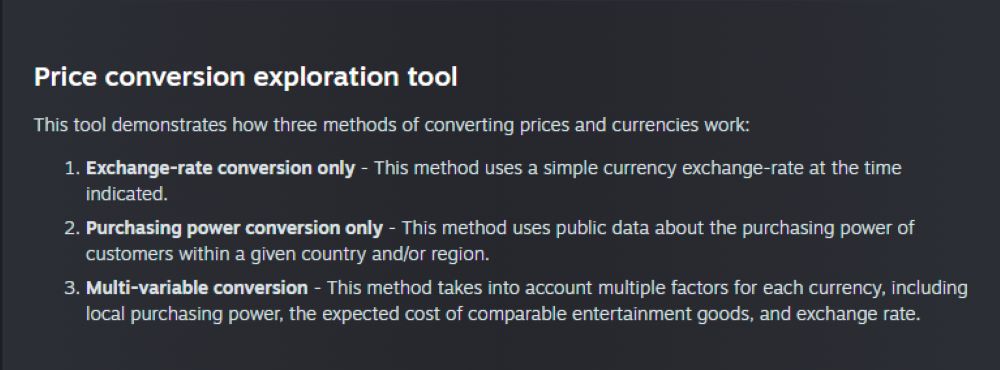
Steam supports pricing in more than 35 currencies and several regional groupings around the world. Setting prices for such a wide variety of markets is complex. To assist developers, Steam provides conversion tools inside Steamworks, the backend system developers use to manage game releases, pricing, updates, and marketing.
When a developer chooses a base USD price, Steam generates suggested local prices for every supported currency based on a selected conversion method. The March 2026 update refreshed the economic data behind these conversion methods to better reflect market conditions as of January 2026. This includes recent exchange rate movements, changes in income levels and purchasing behaviours, and how much players spend on entertainment like games, movies, and subscriptions.
Developers still choose final prices. Steam’s tools do not enforce any price changes. However, since many studios use Steam’s suggested values as a baseline, the updated data can indirectly influence real store prices over time.
How Steam’s Pricing Conversion Tools Work
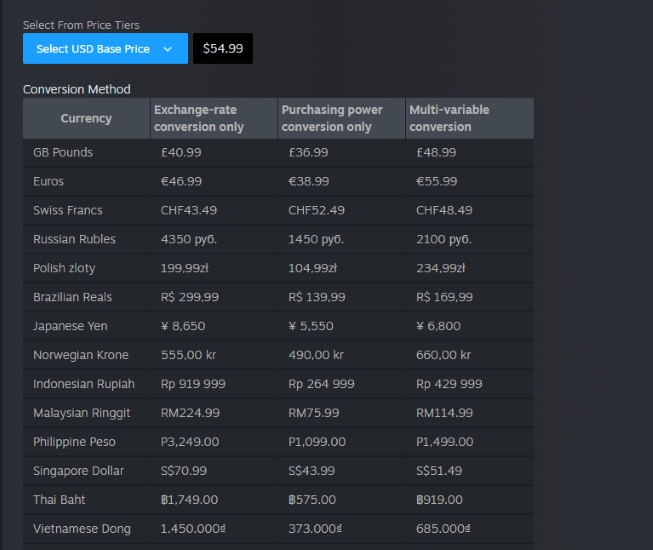
Steam now clearly presents three pricing conversion approaches within Steamworks. Each method takes a different view of how to convert a USD base price into local currency.
These are:
- Exchange Rate Conversion
- Purchasing Power Conversion
- Multi-Variable Conversion
Understanding how each method works helps explain why a USD $59.99 game can produce very different suggested prices depending on the strategy developers choose.
Exchange Rate Conversion: Currency Value Only

The easiest way to think of exchange rate conversion is as “what the game would cost if prices were directly converted using the current foreign exchange rate.”
It does not take into account differences in income or spending habits in each market. It simply multiplies USD by the local currency value at the current exchange rate.
For example, a USD $59.99 base game might be suggested as:
| Country | Price (Exchange Rate) |
| Malaysia | RM244.99 |
| Philippines | ₱3,549 |
| Indonesia | Rp999,999 |
| Thailand | ฿1,899 |
| Singapore | S$76.99 |
| Vietnam | 1,575,000₫ |
At higher price points, this method often results in figures that feel expensive relative to local incomes. Many developers do not follow this method on its own in markets where affordability is a concern.
Real game example:
Games like Call of Duty: Modern Warfare II traditionally launched at around USD $59.99 on Steam. If priced purely by exchange rate, this could mean very high local prices in some Southeast Asia markets.
Exchange rate conversion simply converts a USD base price directly into another currency. For instance, a game like Resident Evil Village, priced at USD $59.99 globally, would suggest RM244.99 in Malaysia or ₱3,549 in the Philippines if this method were used. Similarly, Elden Ring or Marvel’s Spider-Man Remastered would appear equally expensive in absolute terms, which highlights why straight currency conversion can make games inaccessible in emerging Southeast Asian markets.
Purchasing Power Conversion: Local Affordability

This method takes into account how much players in each country can reasonably afford compared to consumers in the United States. Instead of using currency values alone, it uses public data on average earnings and local spending habits.
A USD $59.99 game would be suggested as:
| Country | Price (Purchasing Power) |
| Malaysia | RM82.99 |
| Philippines | ₱1,199 |
| Indonesia | Rp289,999 |
| Thailand | ฿625 |
| Singapore | S$47.99 |
| Vietnam | 407,000₫ |
These figures are lower because they reflect income differences. This method is useful when developers want to set prices that are accessible to local players and avoid pricing games out of reach in lower‑income markets.
Real game example:
Indie titles like Hades or Stardew Valley often sit in price ranges where purchasing power conversion would make them far more affordable in emerging markets than a direct exchange rate would.
Purchasing power conversion adjusts prices to reflect local income levels and spending behaviour. That same Resident Evil Village would convert to RM82.99 in Malaysia or ₱1,199 in the Philippines, making it far more affordable. Mid-tier games like Slay the Spire or Tekken 7, which often sit around USD $19.99, benefit similarly: the gap between exchange-rate and purchasing-power pricing can determine whether players buy at launch or wait for sales. Even indie hits like Hades or Stardew Valley illustrate how lower adjusted prices allow greater uptake in smaller markets.
Multi Variable Conversion: Balancing Multiple Factors

Multi variable conversion uses several data inputs to estimate a balanced price. Steam considers local purchasing power, current exchange rate, and the relative cost of comparable entertainment goods in each market to generate a suggested price.
For USD $59.99 the multi variable recommendations look like:
| Country | Price (Multi Variable) |
| Malaysia | RM129.99 |
| Philippines | ₱1,649 |
| Indonesia | Rp469,999 |
| Thailand | ฿1,049 |
| Singapore | S$54.99 |
| Vietnam | 743,000₫ |
Multi variable is widely treated as the reference point because it balances affordability and expected revenue. Many developers use this method as a starting point and then adjust prices manually if needed.
Real game example:
AAA titles like Resident Evil Village and Resident Evil 4 Remake often use multi-variable pricing for Southeast Asia, balancing access with revenue expectations.
Multi variable conversion blends purchasing power, exchange rate, and the cost of comparable entertainment. Using this method, Resident Evil Village sits around RM129.99 in Malaysia or ₱1,649 in the Philippines. Higher-tier editions like Call of Duty: Modern Warfare II or Assassin’s Creed Valhalla – Ultimate Edition fall in similar mid-range prices, striking a balance between affordability and maintaining global parity. This method often serves as the default reference for developers setting regional pricing.
Why Steam Updated the Conversion Dataset in 2026
Steam’s conversion methods existed long before 2026. What changed with this update was the economic dataset behind them. Currencies, inflation, and global incomes have shifted significantly since the last major pricing revision. More players are buying games digitally, and markets like Southeast Asia are growing fast.
Updating the dataset helps ensure that conversion suggestions match current real‑world conditions rather than outdated values.
Regional Pricing Across Southeast Asia
Here is an example comparison of how the three conversion methods translate into local prices for common Steam price tiers across key Southeast Asian markets.
USD $9.99 Games
| Country | Exchange Rate | Purchasing Power | Difference in % | Multi‑Variable | Difference in % |
| Malaysia | RM40.49 | RM13.75 | -66.0% | RM25.49 | -37.0% |
| Philippines | ₱589 | ₱195 | -66.9% | ₱329 | -44.1% |
| Indonesia | Rp164,999 | Rp48,499 | -70.6% | Rp94,499 | -42.7% |
| Thailand | ฿315 | ฿105 | -66.7% | ฿205 | -34.9% |
| Vietnam | 263,000₫ | 67,500₫ | -74.3% | 149,500₫ | -43.2% |
| Singapore | S$12.75 | S$7.95 | -37.6% | S$11.25 | -11.8% |
USD $19.99 Games
| Country | Exchange Rate | Purchasing Power | Difference in % | Multi‑Variable | Difference in % |
| Malaysia | RM80.99 | RM27.49 | -66.0% | RM46.99 | -42.0% |
| Philippines | ₱1,199 | ₱389 | -67.5% | ₱599 | -50.0% |
| Indonesia | Rp334,999 | Rp96,999 | -71.1% | Rp174,999 | -47.8% |
| Thailand | ฿635 | ฿209 | -67.1% | ฿369 | -41.9% |
| Vietnam | 526,000₫ | 135,500₫ | -74.2% | 274,000₫ | -47.9% |
| Singapore | S$25.75 | S$15.99 | -37.9% | S$20.75 | -19.5% |
USD $59.99 Games
| Country | Exchange Rate | Purchasing Power | Difference in % | Multi‑Variable | Difference in % |
| Malaysia | RM244.99 | RM82.99 | -66.1% | RM129.99 | -46.9% |
| Philippines | ₱3,549 | ₱1,199 | -66.2% | ₱1,649 | -53.5% |
| Indonesia | Rp999,999 | Rp289,999 | -71.0% | Rp469,999 | -53.0% |
| Thailand | ฿1,899 | ฿625 | -67.1% | ฿1,049 | -44.8% |
| Vietnam | 1,575,000₫ | 407,000₫ | -74.2% | 743,000₫ | -52.8% |
| Singapore | S$76.99 | S$47.99 | -37.7% | S$54.99 | -28.6% |
USD $69.99 Games
| Country | Exchange Rate | Purchasing Power | Difference in % | Multi‑Variable | Difference in % |
| Malaysia | RM284.99 | RM95.99 | -66.3% | RM149.99 | -47.4% |
| Philippines | ₱4,149 | ₱1,399 | -66.3% | ₱1,899 | -54.2% |
| Indonesia | Rp1,169,999 | Rp339,999 | -70.9% | Rp544,999 | -53.4% |
| Thailand | ฿2,199 | ฿729 | -66.9% | ฿1,199 | -45.5% |
| Vietnam | 1,845,000₫ | 474,500₫ | -74.3% | 864,000₫ | -53.2% |
| Singapore | S$89.99 | S$55.99 | -37.8% | S$65.99 | -26.7% |
Why These Differences Matter
The data clearly shows how much suggested prices vary based on the conversion method. For price‑sensitive players in Southeast Asia, these differences influence decisions about whether to buy a game at launch, wait for a sale, or skip it altogether.
Affordability and Player Behavior
- In the Philippines and Indonesia, a direct exchange rate price for AAA games often feels high relative to average income and local cost of living. Many players in these markets wait for deep discounts before purchasing.
- In Malaysia and Singapore, multi variable pricing brings prices closer to local expectations while not straying too far from global parity.
- Thailand and Vietnam show similar patterns, where purchasing power pricing lowers price barriers but multi variable pricing still seeks a balance.
How Developers Actually Use These Tools
Developers use these conversion methods differently depending on their goals and resources:
- Indie developers often accept Steam’s multi variable recommendations as defaults because they lack the resources for detailed regional market research.
- Mid‑tier studios may tweak prices manually in each region based on historical sales and community feedback.
- AAA publishers frequently set prices above suggested tiers in mid‑income regions to align with global pricing or console parity.
Community discussions show that many players pay close attention to pricing differences between regions. Some have organized spreadsheets comparing prices for the same game across countries, highlighting apples‑to‑apples cost comparisons that reveal how much impact these tools can have on local budgets.
Will Games Get More Expensive in Southeast Asia?
Many players immediately wonder if the updated Steam conversion dataset means higher prices for games. Based on the data and regional trends, the answer is nuanced.
The new dataset reflects recent exchange rate fluctuations, inflation, and growing digital spending. In markets where purchasing power is lower—such as the Philippines and Indonesia—multi variable pricing still produces prices significantly below direct exchange rate conversion. This means that AAA games are unlikely to suddenly become unaffordable for most players, especially if publishers prioritize accessibility.
However, in mid‑tier markets like Malaysia and Singapore, the multi variable conversion method produces prices closer to exchange rate equivalents. As digital purchasing grows and developers aim for global revenue parity, we could see a gradual increase in suggested prices for new releases, particularly for AAA titles or high-demand games.
Real-world examples support this trend: games like Resident Evil 4 Remake or Call of Duty: Modern Warfare II are often priced using multi variable methods, and in Malaysia and Singapore, these prices have been creeping closer to their global USD equivalents over the past few years. Meanwhile, smaller indie games remain largely priced according to purchasing power, keeping them accessible even in lower-income markets.
In short, games in Southeast Asia are unlikely to experience a sudden price hike, but over time, the gap between local affordability pricing and exchange-rate-based pricing may narrow slightly. Players may notice slightly higher prices for big releases in the next couple of years, while affordability-focused models continue to dominate for smaller titles and sales events.
This trend reflects the maturing digital game market in the region. As developers grow more confident in the data and players increasingly pay for games digitally, Steam’s updated conversion tools may subtly reshape expectations about what a full-price PC release should cost locally.
Conclusion
Steam’s updated regional pricing conversion tools represent a significant evolution in how developers think about global pricing strategy. By offering exchange rate, purchasing power, and multi variable conversion options, Valve helps developers consider economic diversity when setting prices around the world.
For players, this means greater transparency in how prices are calculated and a better chance of seeing pricing that reflects local economic realities. For developers, it underscores the importance of choosing the right pricing model for each market to support both accessibility and revenue goals.
Understanding these tools is now a vital part of launching and sustaining a game internationally, and Southeast Asia stands as one of the most dynamic regions where these decisions matter most.