



















Steam is seeing a fast rise in simple sorting games, and a recent AppMagic analysis says the way they are made and sold looks a lot like the hypercasual playbook long used on mobile. That approach relies on quick production, gameplay that is easy to understand at a glance and many versions of the same proven idea. On Steam, the latest example is a group of games known as collectathons, or tidy-up games, where players enter one space filled with thousands of objects and put everything back where it belongs.
The format builds on cleanup sims such as House Flipper and PowerWash Simulator, which both grew into franchises and sold millions of copies. The first big signal for sorting games came in April with Librarian: Tidy Up the Arcane Library!, which has sold more than 1.6 million copies and earned $9.2 million. Supermarket Chaos followed in late June and brought in $1.8 million from 421,000 copies. None of the releases AppMagic has tracked since has matched Librarian’s numbers.
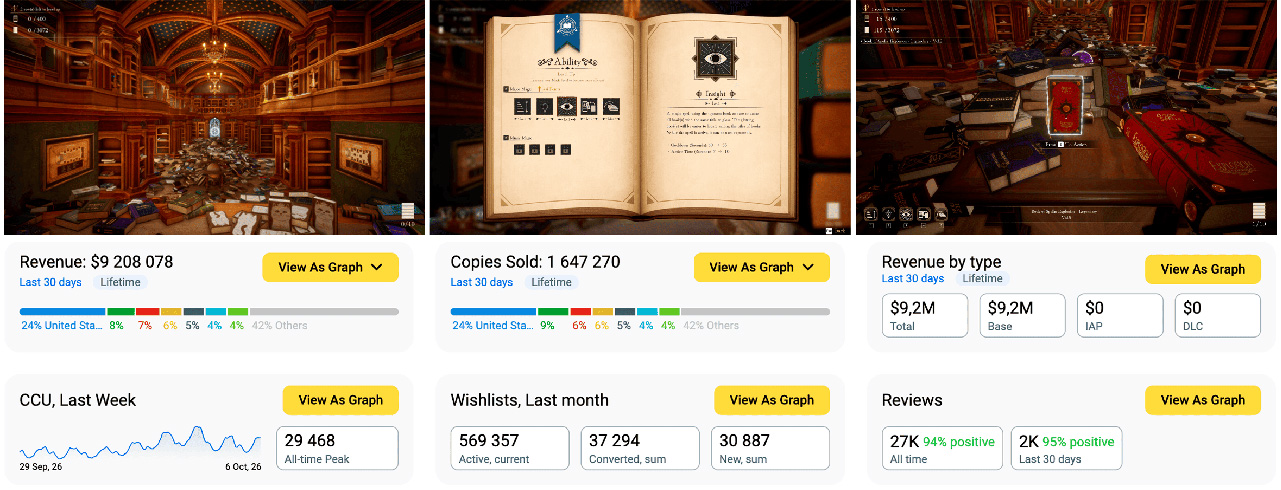
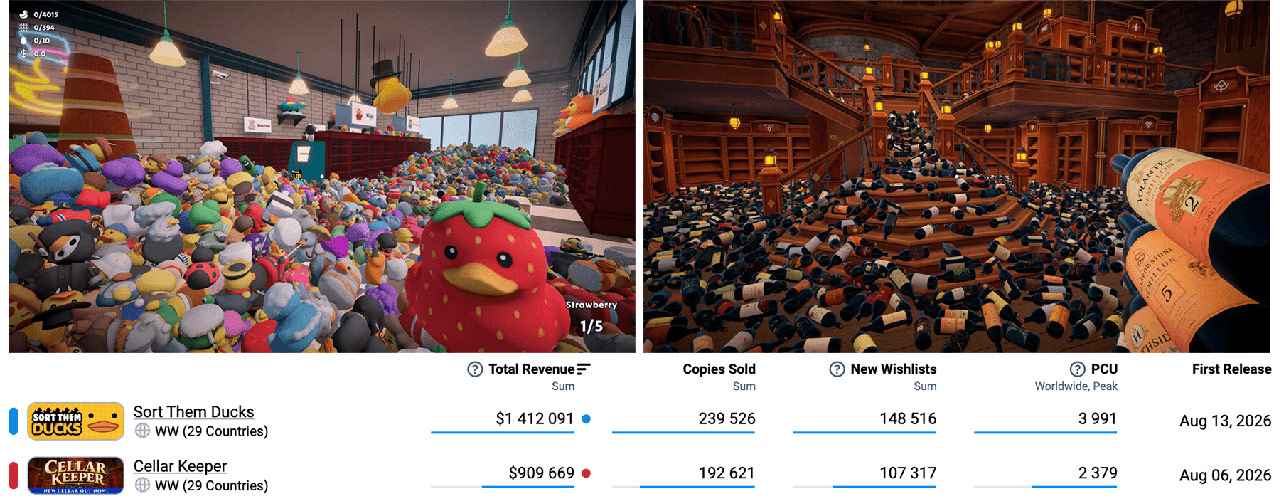
Releases then picked up, with 13 tidy-up games launching in August and roughly 17 more in September, for a total of more than 30. Many try a different setting. Sort Them Ducks has players sort more than 4,000 rubber ducks and has earned $1.4 million from 239,000 copies, while Cellar Keeper, set in a wine cellar with more than 2,400 misplaced bottles, has reached 192,000 copies and $909,000. Others add extra features. Cleaning Up the Puzzle Gallery turns the cleanup into jigsaws and has earned $686,000, and Megastore: Tidy Up Together takes players through four increasingly large stores, solo or in online co-op, and has earned $427,000 so far.
Price is part of the pitch too. Nearly every tidy-up game AppMagic has tracked costs between $4.99 and $5.99, and unlike mobile hypercasual games, which usually depend on ad revenue, these are sold as complete premium games with no microtransactions. Ratings among selected titles range from roughly 73% to 95%, with six of the ten above 90%.
The format also keeps production simple, since one location, a set of existing assets and a solid sorting loop can cover most of the product. AppMagic notes that AI tools can speed things up further, and the team behind Package Chaos has said it used generative AI for its package sticker textures.
AppMagic says Steam is not going hypercasual in a literal sense, and the shift does not cover the whole platform. Some corners of it now use the same logic on Steam’s own terms, with one readable loop, a low price, fast production and a concept that can be shown in a single screenshot, stream or short clip. While mobile games that began simple have spent years adding more progression and systems, these $5 sorting games show how far a single simple loop can go as a complete premium product.